 Miranda LimonczenkoandClaude Opus 5
edf50668aa
Miranda LimonczenkoandClaude Opus 5
edf50668aa
Stacked on #49015, which is stacked on #49011. Review those first.

## Problem

The Row Level Security guide spent 225 lines and 5 benchmark tables on
performance, 29% of the page. The `RLS Performance and Best Practices`
troubleshooting entry already covers the same six tips with the same
numbers, from the same source. Neither page tells you how to check
whether RLS is your bottleneck in the first place.

Four of the six tips are not tuning advice. Indexes, `select`-wrapping,
role scoping, and `security definer` safety change whether a policy is
correct and safe, not just fast.

## Solution

- Add `guides/database/postgres/row-level-security-performance`. It
carries the client-filter rule, the join-rewrite rule, all 5 benchmark
tables merged into one, and a new `Diagnose whether RLS is the
bottleneck` section: toggle RLS off to confirm it's the cost, then read
the plan under an impersonated role. That diagnostic exists in the
troubleshooting entry and has never been in the guide.
- Keep every rule that affects correctness on the RLS guide, grouped
under `Write policies that scale`. These are also the four the
`build-docs-002-rls-guide` eval grades, and an agent reads the guide
top-down.
- Repoint the Grafana IO troubleshooting entry at the new page.
- Rewrite `More resources` as `Related content`. Every link now says
what it is and when to use it. Adds `Advanced pgTAP testing`, the
deepest RLS testing content in the docs, which nothing here linked.
Drops discussion 14576: locked, mislabeled here as "RLS Guide and Best
Practices" when it is "RLS **Performance** and Best Practices", and
superseded by the troubleshooting entry and this new page.

**Ownership rule** so the two pages don't drift: the RLS guide owns the
rule and the correct form. The performance page owns the measurement and
the optimizer explanation. If a sentence on the performance page tells
you what to write, it belongs on the guide.

Scoped out of this PR: `More resources` was assigned to the restructure
PR in the plan, but the 14576 link is what this PR supersedes, so
leaving it would ship a stale pointer.

## Manual testing

1. Open the [RLS performance
guide](https://docs-git-docs-rls-performance-split-supabase.vercel.app/docs/guides/database/postgres/row-level-security-performance)
on the preview. It appears in the left nav under Database, Access and
security, directly below Row Level Security.
2. Select the three rule links in its intro. Each lands on the matching
section of the RLS guide.
3. Open the [Row Level Security
guide](https://docs-git-docs-rls-performance-split-supabase.vercel.app/docs/guides/database/postgres/row-level-security)
and go to `Write policies that scale`. It holds indexes,
`select`-wrapping, and role scoping, with one link out to the
performance page.
4. Open the [Grafana IO troubleshooting
entry](https://docs-git-docs-rls-performance-split-supabase.vercel.app/docs/guides/troubleshooting/interpreting-supabase-grafana-io-charts-MUynDR)
and select the RLS performance guide link. It lands on the new page.

<!-- This is an auto-generated comment: release notes by coderabbit.ai
-->

## Summary by CodeRabbit

* **Documentation**
* Added a dedicated guide for diagnosing and improving PostgreSQL Row
Level Security performance.
* Expanded guidance on indexing, query filters, role targeting, function
usage, and avoiding costly policy joins.
* Updated the Row Level Security guide with streamlined, scalable policy
recommendations and links to related resources.
* Added the new performance guide to the Database documentation
navigation.
* Updated troubleshooting guidance to reference the dedicated
performance guide.

<!-- end of auto-generated comment: release notes by coderabbit.ai -->

---------

Co-authored-by: Claude Opus 5 <noreply@anthropic.com>


Supabase
Supabase is the Postgres development platform. We're building the features of Firebase using enterprise-grade open source tools.
- Hosted Postgres Database. Docs
- Authentication and Authorization. Docs
- Auto-generated APIs.
- Functions.
- File Storage. Docs
- AI + Vector/Embeddings Toolkit. Docs
- Dashboard
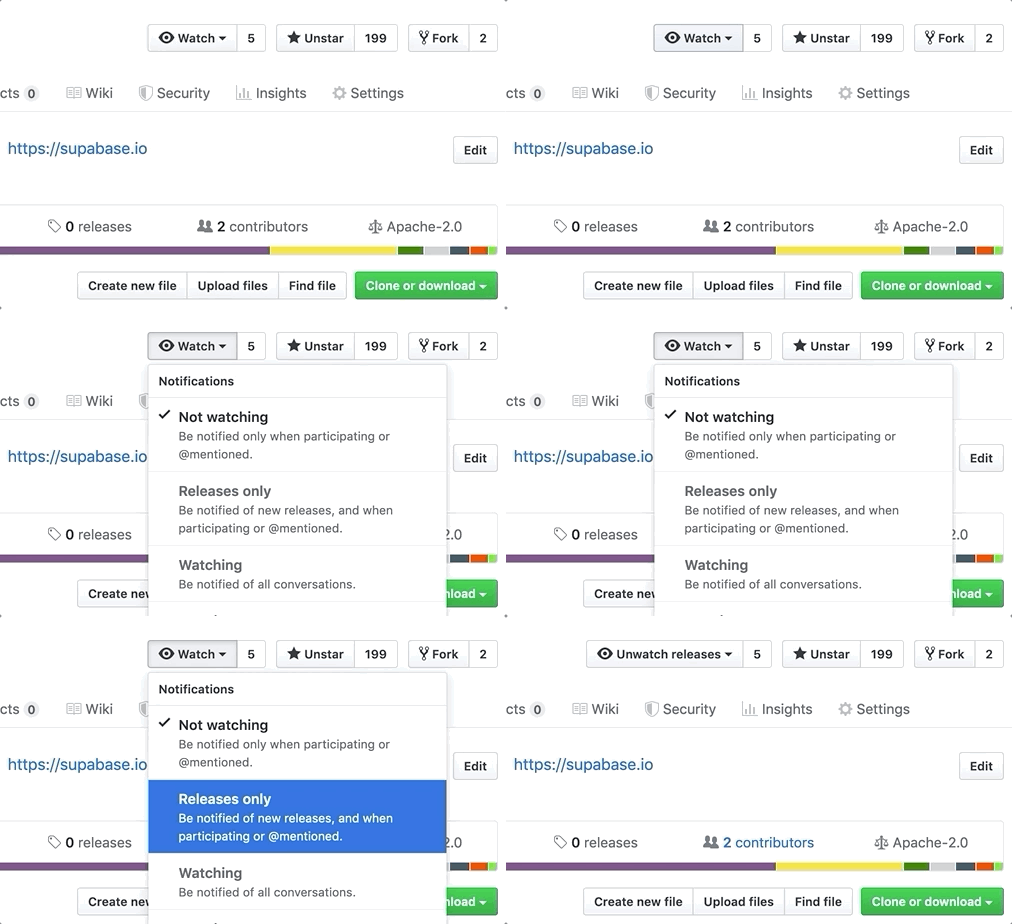
Watch "releases" of this repo to get notified of major updates.
Documentation
For full documentation, visit supabase.com/docs
To see how to Contribute, visit Getting Started
Community & Support
- Community Forum. Best for: help with building, discussion about database best practices.
- GitHub Issues. Best for: bugs and errors you encounter using Supabase.
- Email Support. Best for: problems with your database or infrastructure.
- Discord. Best for: sharing your applications and hanging out with the community.
How it works
Supabase is a combination of open source tools. We’re building the features of Firebase using enterprise-grade, open source products. If the tools and communities exist, with an MIT, Apache 2, or equivalent open license, we will use and support that tool. If the tool doesn't exist, we build and open source it ourselves. Supabase is not a 1-to-1 mapping of Firebase. Our aim is to give developers a Firebase-like developer experience using open source tools.
Architecture
Supabase is a hosted platform. You can sign up and start using Supabase without installing anything. You can also self-host and develop locally.

- Postgres is an object-relational database system with over 30 years of active development that has earned it a strong reputation for reliability, feature robustness, and performance.
- Realtime is an Elixir server that allows you to listen to PostgreSQL inserts, updates, and deletes using websockets. Realtime polls Postgres' built-in replication functionality for database changes, converts changes to JSON, then broadcasts the JSON over websockets to authorized clients.
- PostgREST is a web server that turns your PostgreSQL database directly into a RESTful API.
- GoTrue is a JWT-based authentication API that simplifies user sign-ups, logins, and session management in your applications.
- Storage a RESTful API for managing files in S3, with Postgres handling permissions.
- pg_graphql a PostgreSQL extension that exposes a GraphQL API.
- postgres-meta is a RESTful API for managing your Postgres, allowing you to fetch tables, add roles, and run queries, etc.
- Envoy is a cloud-native, high-performance edge and service proxy.
Client libraries
Our approach for client libraries is modular. Each sub-library is a standalone implementation for a single external system. This is one of the ways we support existing tools.
| Language | Client | Feature-Clients (bundled in Supabase client) | ||||
|---|---|---|---|---|---|---|
| Supabase | PostgREST | GoTrue | Realtime | Storage | Functions | |
| ⚡️ Official ⚡️ | ||||||
| JavaScript (TypeScript) | supabase-js | postgrest-js | auth-js | realtime-js | storage-js | functions-js |
| Flutter | supabase-flutter | postgrest-dart | gotrue-dart | realtime-dart | storage-dart | functions-dart |
| Swift | supabase-swift | postgrest-swift | auth-swift | realtime-swift | storage-swift | functions-swift |
| Python | supabase-py | postgrest-py | gotrue-py | realtime-py | storage-py | functions-py |
| 💚 Community 💚 | ||||||
| C# | supabase-csharp | postgrest-csharp | gotrue-csharp | realtime-csharp | storage-csharp | functions-csharp |
| Go | - | postgrest-go | gotrue-go | - | storage-go | functions-go |
| Java | - | - | gotrue-java | - | storage-java | - |
| Kotlin | supabase-kt | postgrest-kt | auth-kt | realtime-kt | storage-kt | functions-kt |
| Ruby | supabase-rb | postgrest-rb | - | - | - | - |
| Rust | - | postgrest-rs | - | - | - | - |
| Godot Engine (GDScript) | supabase-gdscript | - | - | - | - | - |
Badges

[](https://supabase.com)
<a href="https://supabase.com">
  <img
    width="168"
    height="30"
    src="https://supabase.com/badge-made-with-supabase.svg"
    alt="Made with Supabase"
  />
</a>

[](https://supabase.com)
<a href="https://supabase.com">
  <img
    width="168"
    height="30"
    src="https://supabase.com/badge-made-with-supabase-dark.svg"
    alt="Made with Supabase"
  />
</a>
Translations
- Arabic | العربية
- Albanian / Shqip
- Bangla / বাংলা
- Bulgarian / Български
- Catalan / Català
- Croatian / Hrvatski
- Czech / čeština
- Danish / Dansk
- Dutch / Nederlands
- English
- Estonian / eesti keel
- Finnish / Suomalainen
- French / Français
- German / Deutsch
- Greek / Ελληνικά
- Gujarati / ગુજરાતી
- Hebrew / עברית
- Hindi / हिंदी
- Hungarian / Magyar
- Nepali / नेपाली
- Indonesian / Bahasa Indonesia
- Italiano / Italian
- Japanese / 日本語
- Korean / 한국어
- Lithuanian / lietuvių
- Latvian / latviski
- Malay / Bahasa Malaysia
- Norwegian (Bokmål) / Norsk (Bokmål)
- Persian / فارسی
- Polish / Polski
- Portuguese / Português
- Portuguese (Brazilian) / Português Brasileiro
- Romanian / Română
- Russian / Pусский
- Serbian / Srpski
- Sinhala / සිංහල
- Slovak / slovenský
- Slovenian / Slovenščina
- Spanish / Español
- Simplified Chinese / 简体中文
- Swedish / Svenska
- Thai / ไทย
- Traditional Chinese / 繁體中文
- Turkish / Türkçe
- Ukrainian / Українська
- Vietnamese / Tiếng Việt
- List of translations