 Saxon Fletcher
a045804e73
Saxon Fletcher
a045804e73
<img width="1510" height="860" alt="image"
src="https://github.com/user-attachments/assets/36a748b7-bdeb-4685-8bb1-da911711874b"
/>


Introduces a new OAuth consent block in preparation for offering more
MCP focused blocks that require authentication and consent. The general
approach for this is to decouple consent block from authentication block
but provide guidance on how to use both. The alternative is to add auth
as a dependency to consent but apps may already have their own
authentication UI / flows.

The block is also positioned as a general OAuth Consent vs MCP Consent
as it can be put to use for other use cases outside of MCP on projects
who want to make use of the OAuth 2.1 Server offering.

A couple of changes outside of the block itself were required:
- Updated the Auth blocks to allow for a `next` param to redirect users
to after signing in
- Updated middleware so next param is correctly passed through to sign
in

## How to test

Requires Docker and a Supabase CLI recent enough to support
`[auth.oauth_server]` (verified on 2.109.0 / GoTrue v2.192.0).

### 1. Local Supabase with the OAuth server enabled

In your `supabase/config.toml`, edit the existing `[auth.oauth_server]`
section — `supabase init` already writes one, and adding a second fails
with `table oauth_server already exists`:

```toml
[auth.oauth_server]
enabled = true
authorization_url_path = "/oauth/consent"
allow_dynamic_registration = true
```

Set `site_url` to wherever your test app runs (e.g.
`http://localhost:3100`), then `supabase start`. Grab the API URL and
publishable key from `supabase status`.

### 2. A consumer app with the blocks installed

The consent block ships no login route by design, so pair it with an
auth block:

```bash
npx create-next-app@latest consent-test --ts --tailwind --app --yes
```

```bash
cd consent-test && npx shadcn@latest init -d -y && npx shadcn@latest add https://supabase.com/library/r/password-based-auth-nextjs.json https://supabase.com/library/r/oauth-consent-nextjs.json
```

To test this branch before it deploys, run `pnpm --filter ui-library
dev` and use `http://localhost:3004/library/r/...` instead. If you
changed anything under `registry/default/blocks/oauth-consent/**`, run
`pnpm --filter ui-library build:registry` first — shadcn fetches the
generated `public/r/*.json`, not the source.

Put `NEXT_PUBLIC_SUPABASE_URL` and
`NEXT_PUBLIC_SUPABASE_PUBLISHABLE_KEY` in `.env.local` and start the app
on the port you set as `site_url`.

### 3. Register an OAuth client and start a real authorization request

```bash
curl -s -X POST http://127.0.0.1:54321/auth/v1/oauth/clients/register -H "Content-Type: application/json" -d '{"client_name":"Test Client","redirect_uris":["http://localhost:3100/callback"],"grant_types":["authorization_code"],"response_types":["code"],"scope":"openid profile email"}'
```

Then open the authorize URL in a browser (not curl — you need the
redirect chain and cookies):

```
http://127.0.0.1:54321/auth/v1/oauth/authorize?client_id=<id>&response_type=code&redirect_uri=http://localhost:3100/callback&scope=openid+profile+email&state=xyz&code_challenge=<challenge>&code_challenge_method=S256
```

Auth mints the `authorization_id` and redirects to
`<site_url>/oauth/consent?authorization_id=…`. An MCP client pointed at
your app is an even better driver, since that's the real consumer shape.

### 4. Cases to walk

| Case | Expected |
| --- | --- |
| Signed out, hit the authorize URL | Lands on
`/auth/login?next=%2Foauth%2Fconsent%3Fauthorization_id%3D…`; after
login, returns to the consent screen |
| Consent screen | Shows client name, redirect URI, signed-in email, and
requested scopes from `getAuthorizationDetails` |
| Allow access | Redirects to `redirect_uri` with `code` and your
original `state`; the code exchanges at `/oauth/token` for a real access
token |
| Deny | Redirects with `error=access_denied` and your `state` |
| Re-run the same authorize URL after approving | Skips the screen,
straight to callback with a new code |
| Visit `/oauth/consent` with no `authorization_id` | "This page needs
an authorization_id" |
| Stale or bogus `authorization_id` | Error shown, buttons still usable
|
| Double-click Allow | Exactly one `POST
/oauth/authorizations/<id>/consent` |

Test the react, react-router, or tanstack variant the same way if you're
touching them — the hook is duplicated per framework, so a fix in one
doesn't carry.

<!-- This is an auto-generated comment: release notes by coderabbit.ai
-->
## Summary by CodeRabbit

* **New Features**
* Added an OAuth 2.1 consent experience with client details, requested
scopes, redirect URI, and approve/deny actions.
* Added OAuth consent examples and registry blocks for Next.js, React,
React Router, and TanStack Start.
* Added OAuth documentation, navigation, and framework support across
the UI library.
* **Bug Fixes**
* Login flows now safely preserve valid same-origin redirect
destinations while rejecting unsafe URLs.
* OAuth routes can handle consent flows before authentication and
redirect safely to sign-in.
<!-- end of auto-generated comment: release notes by coderabbit.ai -->


Supabase
Supabase is the Postgres development platform. We're building the features of Firebase using enterprise-grade open source tools.
- Hosted Postgres Database. Docs
- Authentication and Authorization. Docs
- Auto-generated APIs.
- Functions.
- File Storage. Docs
- AI + Vector/Embeddings Toolkit. Docs
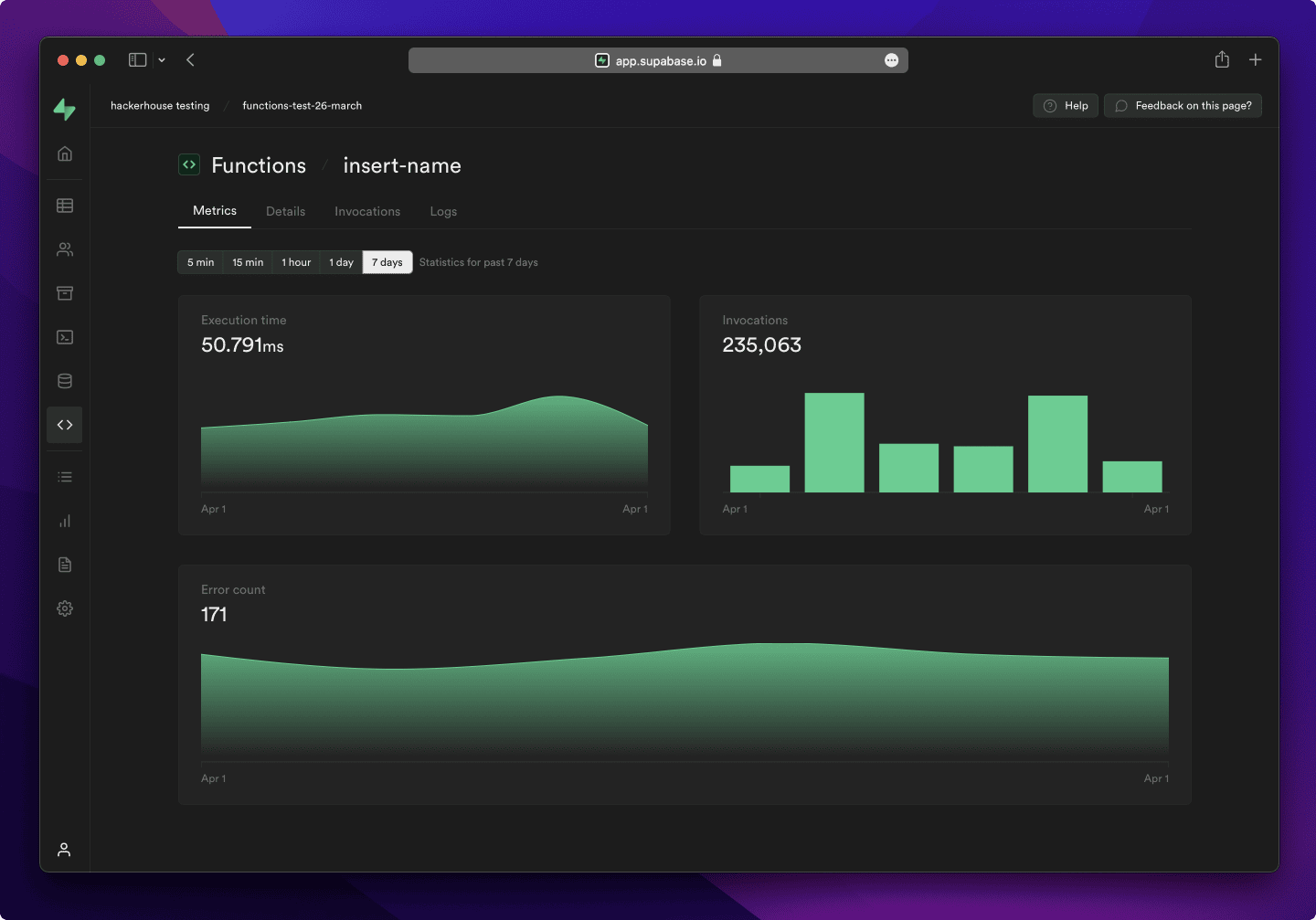
- Dashboard
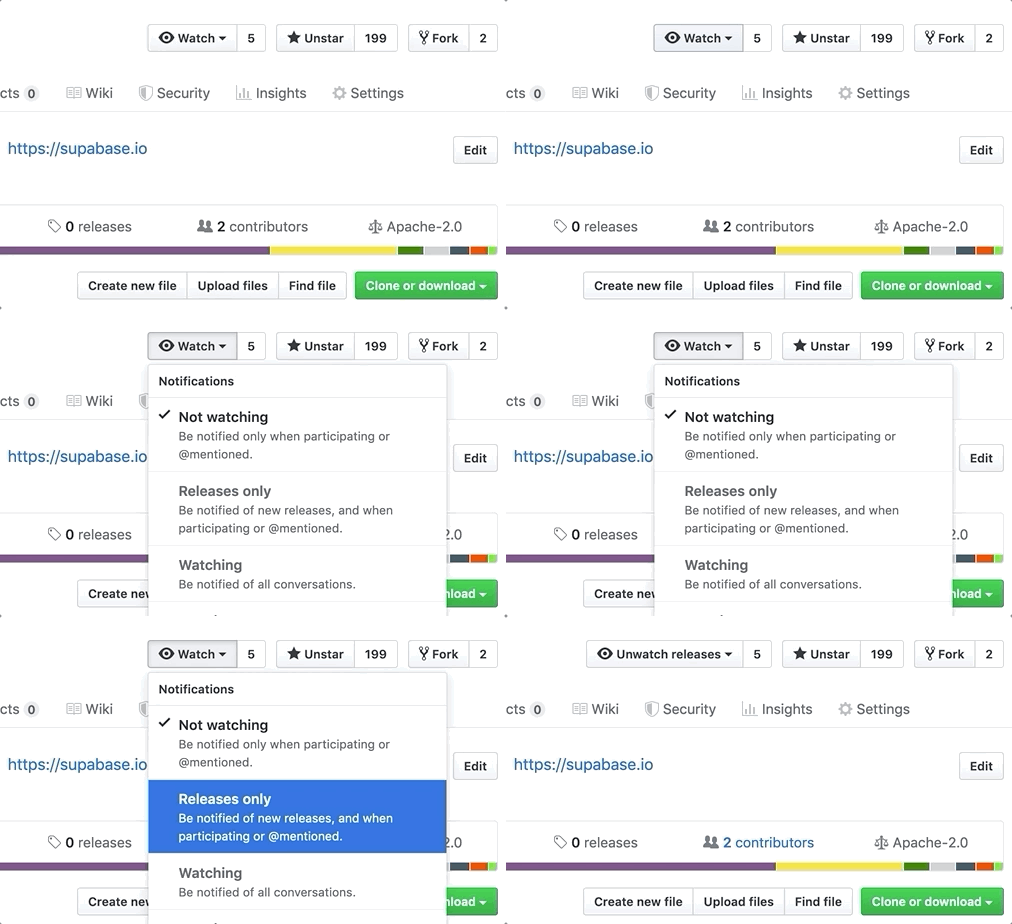
Watch "releases" of this repo to get notified of major updates.
Documentation
For full documentation, visit supabase.com/docs
To see how to Contribute, visit Getting Started
Community & Support
- Community Forum. Best for: help with building, discussion about database best practices.
- GitHub Issues. Best for: bugs and errors you encounter using Supabase.
- Email Support. Best for: problems with your database or infrastructure.
- Discord. Best for: sharing your applications and hanging out with the community.
How it works
Supabase is a combination of open source tools. We’re building the features of Firebase using enterprise-grade, open source products. If the tools and communities exist, with an MIT, Apache 2, or equivalent open license, we will use and support that tool. If the tool doesn't exist, we build and open source it ourselves. Supabase is not a 1-to-1 mapping of Firebase. Our aim is to give developers a Firebase-like developer experience using open source tools.
Architecture
Supabase is a hosted platform. You can sign up and start using Supabase without installing anything. You can also self-host and develop locally.

- Postgres is an object-relational database system with over 30 years of active development that has earned it a strong reputation for reliability, feature robustness, and performance.
- Realtime is an Elixir server that allows you to listen to PostgreSQL inserts, updates, and deletes using websockets. Realtime polls Postgres' built-in replication functionality for database changes, converts changes to JSON, then broadcasts the JSON over websockets to authorized clients.
- PostgREST is a web server that turns your PostgreSQL database directly into a RESTful API.
- GoTrue is a JWT-based authentication API that simplifies user sign-ups, logins, and session management in your applications.
- Storage a RESTful API for managing files in S3, with Postgres handling permissions.
- pg_graphql a PostgreSQL extension that exposes a GraphQL API.
- postgres-meta is a RESTful API for managing your Postgres, allowing you to fetch tables, add roles, and run queries, etc.
- Envoy is a cloud-native, high-performance edge and service proxy.
Client libraries
Our approach for client libraries is modular. Each sub-library is a standalone implementation for a single external system. This is one of the ways we support existing tools.
| Language | Client | Feature-Clients (bundled in Supabase client) | ||||
|---|---|---|---|---|---|---|
| Supabase | PostgREST | GoTrue | Realtime | Storage | Functions | |
| ⚡️ Official ⚡️ | ||||||
| JavaScript (TypeScript) | supabase-js | postgrest-js | auth-js | realtime-js | storage-js | functions-js |
| Flutter | supabase-flutter | postgrest-dart | gotrue-dart | realtime-dart | storage-dart | functions-dart |
| Swift | supabase-swift | postgrest-swift | auth-swift | realtime-swift | storage-swift | functions-swift |
| Python | supabase-py | postgrest-py | gotrue-py | realtime-py | storage-py | functions-py |
| 💚 Community 💚 | ||||||
| C# | supabase-csharp | postgrest-csharp | gotrue-csharp | realtime-csharp | storage-csharp | functions-csharp |
| Go | - | postgrest-go | gotrue-go | - | storage-go | functions-go |
| Java | - | - | gotrue-java | - | storage-java | - |
| Kotlin | supabase-kt | postgrest-kt | auth-kt | realtime-kt | storage-kt | functions-kt |
| Ruby | supabase-rb | postgrest-rb | - | - | - | - |
| Rust | - | postgrest-rs | - | - | - | - |
| Godot Engine (GDScript) | supabase-gdscript | - | - | - | - | - |
Badges

[](https://supabase.com)
<a href="https://supabase.com">
  <img
    width="168"
    height="30"
    src="https://supabase.com/badge-made-with-supabase.svg"
    alt="Made with Supabase"
  />
</a>

[](https://supabase.com)
<a href="https://supabase.com">
  <img
    width="168"
    height="30"
    src="https://supabase.com/badge-made-with-supabase-dark.svg"
    alt="Made with Supabase"
  />
</a>
Translations
- Arabic | العربية
- Albanian / Shqip
- Bangla / বাংলা
- Bulgarian / Български
- Catalan / Català
- Croatian / Hrvatski
- Czech / čeština
- Danish / Dansk
- Dutch / Nederlands
- English
- Estonian / eesti keel
- Finnish / Suomalainen
- French / Français
- German / Deutsch
- Greek / Ελληνικά
- Gujarati / ગુજરાતી
- Hebrew / עברית
- Hindi / हिंदी
- Hungarian / Magyar
- Nepali / नेपाली
- Indonesian / Bahasa Indonesia
- Italiano / Italian
- Japanese / 日本語
- Korean / 한국어
- Lithuanian / lietuvių
- Latvian / latviski
- Malay / Bahasa Malaysia
- Norwegian (Bokmål) / Norsk (Bokmål)
- Persian / فارسی
- Polish / Polski
- Portuguese / Português
- Portuguese (Brazilian) / Português Brasileiro
- Romanian / Română
- Russian / Pусский
- Serbian / Srpski
- Sinhala / සිංහල
- Slovak / slovenský
- Slovenian / Slovenščina
- Spanish / Español
- Simplified Chinese / 简体中文
- Swedish / Svenska
- Thai / ไทย
- Traditional Chinese / 繁體中文
- Turkish / Türkçe
- Ukrainian / Українська
- Vietnamese / Tiếng Việt
- List of translations