 Sean Oliver
d439ba57f4
Sean Oliver
d439ba57f4
## I have read the
[CONTRIBUTING.md](https://github.com/supabase/supabase/blob/master/CONTRIBUTING.md)
file.

YES

## What kind of change does this PR introduce?

Hardening ahead of any decision to enable session replay, plus a
dependency bump. Follow-up to #48515.

### What's inside

- ~50 lines of logic: the callback, the `url()` pattern, and the theme
and SVG-reference gates
([session-replay.ts](https://github.com/supabase/supabase/pull/48818/changes#diff-b7e4f10387ee7a116dd1673f70a55c0ba066687ff2d228bc2320eba75a349fac))
- ~170 lines of allowlist, one attribute name per line, skimmable ([same
file](https://github.com/supabase/supabase/pull/48818/changes#diff-b7e4f10387ee7a116dd1673f70a55c0ba066687ff2d228bc2320eba75a349fac))
- ~150 lines of comments saying why each group is allowlisted, since a
wrong entry is a privacy or a fidelity bug ([same
file](https://github.com/supabase/supabase/pull/48818/changes#diff-b7e4f10387ee7a116dd1673f70a55c0ba066687ff2d228bc2320eba75a349fac))
- ~430 lines of tests, one case per policy decision
([session-replay.test.ts](https://github.com/supabase/supabase/pull/48818/changes#diff-f9feb872ad0136cf87c7e9fb2af72eb3f4019464c06f0b7dd050ffb85373ccb8))
- 1 line of dependency bump, plus its lockfile
([package.json](https://github.com/supabase/supabase/pull/48818/changes#diff-50d7c39a9430d37971aa76858165ab4f7921c4cc4340b28e9b673ce6982e63cf))

## What is the current behavior?

Session replay is disabled in every environment, and no recordings
exist. This is about what a recording *would* contain if it were ever
switched on.

Attributes are the one channel replay masking cannot reach. `maskTextFn`
only sees DOM text nodes, so a component interpolating customer data
into a `placeholder`, `title` or `aria-label` would be captured
verbatim. Before `posthog-js` 1.413.0 there was no hook for it at all,
and the only mitigation was blocking the element, which drops it from
the capture entirely.

Two places in Studio where that would apply:

- `CreateOrUpdateCustomProviderSheet.tsx:506-507` interpolates the
project's API host into both `value` and `placeholder`. The `value` is
masked. The `placeholder` is not.
- `FileExplorerHeader.tsx:185` renders `Search in
${currentFolderName}...`, a customer storage folder name.

The list is not complete. Any component echoing context into a tooltip
reproduces it, and the author has no reason to be thinking about replay.

Linear [GROWTH-1094](https://linear.app/supabase/issue/GROWTH-1094).
Blocks [GROWTH-1073](https://linear.app/supabase/issue/GROWTH-1073).

## What is the new behavior?

`maskAttributeFn` with a default-deny policy: an allowlist of the
attributes replay needs to render, everything else masked.

### Policy edge cases

- **rrweb's `rr_*` layout attributes have to be allowlisted
explicitly.** posthog-js only applies its own exemption for those when
`maskAllElementAttributes` does the masking. A callback does not get the
exemption.
- **HTML `id` is masked. SVG `id` passes.** `AreaChart.tsx:119` emits
`<linearGradient id="colorUv">` and references it as
`fill="url(#colorUv)"`, so masking it breaks the gradient. But Studio
also binds customer-named values to `id` (`bucket.id` is a storage
bucket name). Split on `element.namespaceURI`.
- **SVG reference attributes pass only fragment-only targets.** recharts
clips every series with `clip-path="url(#clipPath-<id>)"`, so
`clip-path`, `mask`, `filter`, `marker-*`, `fill` and `stroke` have to
survive. They accept external URLs too, so the policy checks the target
rather than allowlisting the attribute name.
- **The `url()` pattern consumes escaped delimiters and ignores case.**
A target containing a quote serializes as `\"` and one containing a
bracket as `\)`, so a naive `[^")]*` stops at the backslash and leaves
the tail of the URL recorded. `URL(...)` is the same function as
`url(...)`. A token the pattern cannot parse falls through to a masking
fallback rather than passing.
- **`url()` targets inside `style` are masked, keeping the
declarations.** The feedback widget puts `toPng(document.body)`, a
base64 PNG of the whole dashboard, into a `background-image`, and the
storage preview panes put signed object URLs there. No other masking
path covers those, because they are not text nodes, a canvas, a network
request or an `img src`.

The config also pins `maskAllElementAttributes: false`. Left unset it
resolves from the PostHog UI, and `true` discards `maskAttributeFn`
entirely.

The `posthog-js` floor rises to `^1.416.1`, the first version carrying
both attribute masking and the "coarse option wins" precedence.

This does not enable recording anywhere.

## Additional context

### Verification

Ran on the studio-staging preview against a live session: 817 seconds,
190 clicks, 82 keypresses. Staging has no server-side masking config, so
everything masked came from this code.

| Check | Result |
|---|---|
| Storage folder search placeholder | Asterisked. Pre-fix it read
`Search in <folder>...` |
| Custom auth provider sheet | Fully masked, including the callback URL
field |
| Canary folder name in event properties | 0 hits, with 51 events in the
session as the control |
| Console capture | `console_log_count: 0` despite the project having
`capture_console_log_opt_in: true` |
| Telemetry regression | None: `$pageview` x34, `$pageleave` x5,
`$groupidentify` x4, `$identify` x1 |

Recording was scoped to that one preview by an origin restriction plus a
URL trigger. Both were reverted afterwards along with the project
toggle.

The policy has 175 unit tests. Separately, the config was bundled with
esbuild and applied to a DOM reproducing Studio's serialized output (the
AreaChart gradient, a recharts `clip-path`, a lucide icon, an inline
`background-image`), and the chart, gradient fill and icon come out
pixel-identical.

### Known fidelity costs

- `img src` is masked, so images don't render in replay. Storage object
URLs are signed customer content.
- `ProviderIcon` renders its mark as `maskImage: url(<src>)` and
`normalizeIconPath` accepts absolute URLs, so provider icons don't
render either.

### Out of scope

rrweb records `<style>` element text without calling either masking
function, because its text-node serializer skips masking when the parent
is `STYLE`. This PR does not reach that channel. Fixed separately in
#50270 / [GROWTH-1229](https://linear.app/supabase/issue/GROWTH-1229).

`captureJsonLd` also defaults on as of PostHog's 2026-08-30 defaults,
which is a capture channel masking doesn't reach. Studio renders no
`ld+json`, so it's inert there, and pinning it off was left out to keep
this PR to its scope.

### The allowlist is the weak part

The policy is default-deny over attribute *names*, so its surface is
every attribute any shipped library emits, and that set grows with each
dependency. A miss is also invisible to these tests, which assert what
the function returns rather than whether some selector elsewhere still
matches. Both failure directions are reachable that way: an attribute
carrying customer data, and an attribute a stylesheet needs.

[GROWTH-1232](https://linear.app/supabase/issue/GROWTH-1232) tracks the
mechanism change: scope by namespace instead of by name, since 50 of the
159 entries exist only to serve SVG rendering, plus a conformance test
that derives the expected set from the codebase so a new dependency
fails CI rather than degrading a replay. Deliberately not done here,
since rewriting the mechanism of a privacy control buys maintainability
rather than correctness.


Supabase
Supabase is the Postgres development platform. We're building the features of Firebase using enterprise-grade open source tools.
- Hosted Postgres Database. Docs
- Authentication and Authorization. Docs
- Auto-generated APIs.
- Functions.
- File Storage. Docs
- AI + Vector/Embeddings Toolkit. Docs
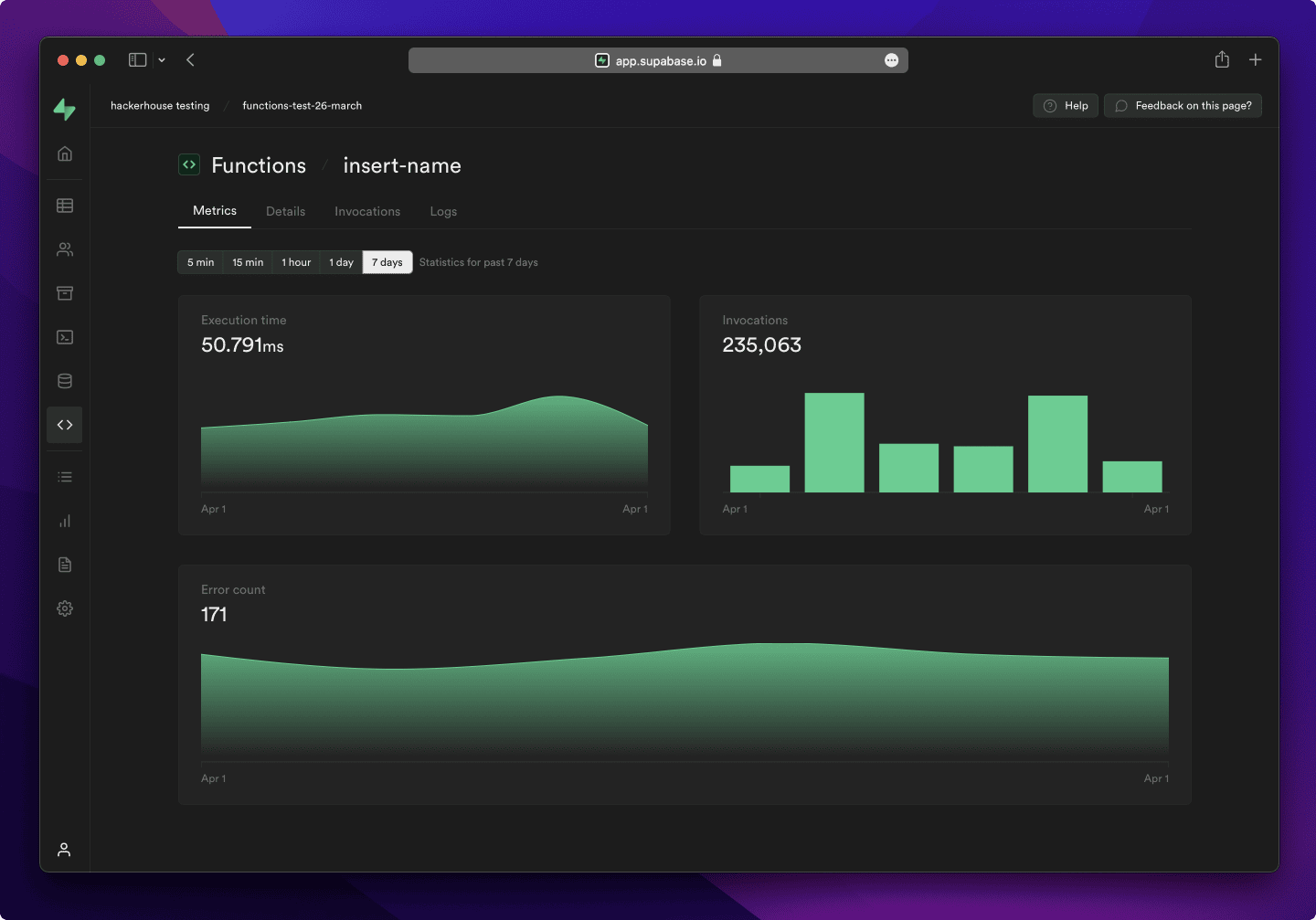
- Dashboard
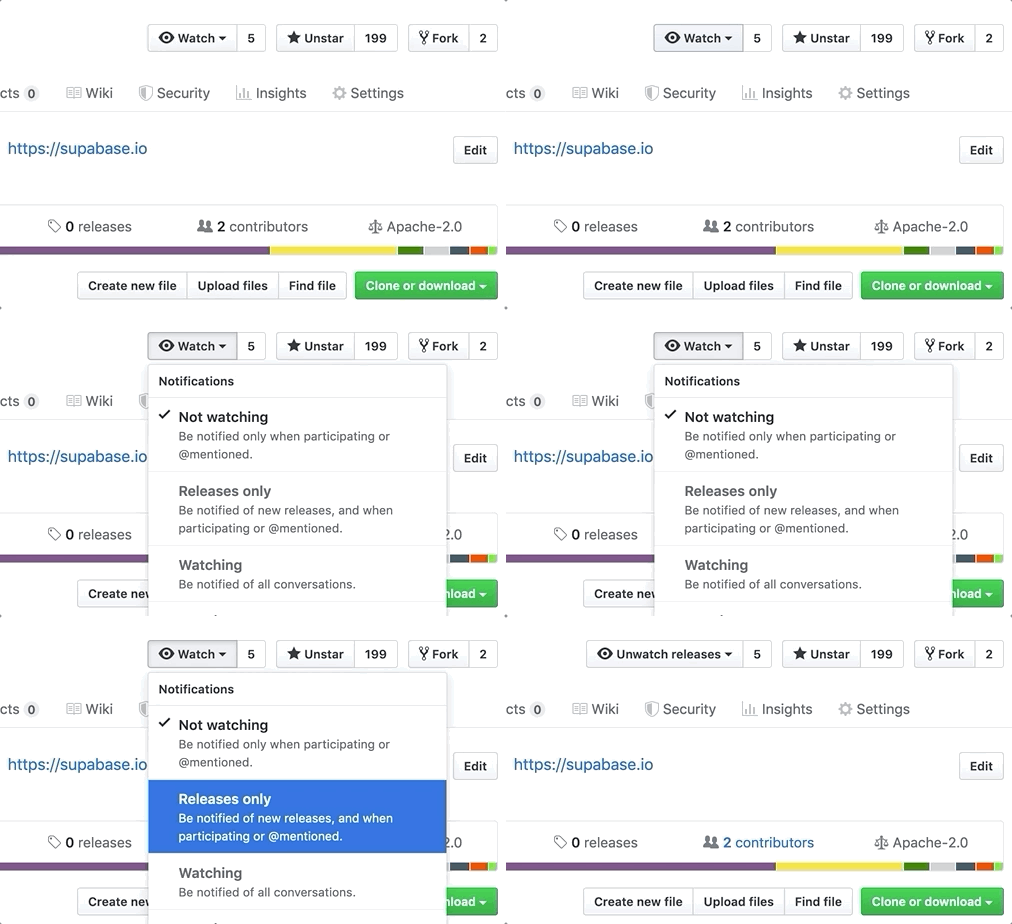
Watch "releases" of this repo to get notified of major updates.
Documentation
For full documentation, visit supabase.com/docs
To see how to Contribute, visit Getting Started
Community & Support
- Community Forum. Best for: help with building, discussion about database best practices.
- GitHub Issues. Best for: bugs and errors you encounter using Supabase.
- Email Support. Best for: problems with your database or infrastructure.
- Discord. Best for: sharing your applications and hanging out with the community.
How it works
Supabase is a combination of open source tools. We’re building the features of Firebase using enterprise-grade, open source products. If the tools and communities exist, with an MIT, Apache 2, or equivalent open license, we will use and support that tool. If the tool doesn't exist, we build and open source it ourselves. Supabase is not a 1-to-1 mapping of Firebase. Our aim is to give developers a Firebase-like developer experience using open source tools.
Architecture
Supabase is a hosted platform. You can sign up and start using Supabase without installing anything. You can also self-host and develop locally.

- Postgres is an object-relational database system with over 30 years of active development that has earned it a strong reputation for reliability, feature robustness, and performance.
- Realtime is an Elixir server that allows you to listen to PostgreSQL inserts, updates, and deletes using websockets. Realtime polls Postgres' built-in replication functionality for database changes, converts changes to JSON, then broadcasts the JSON over websockets to authorized clients.
- PostgREST is a web server that turns your PostgreSQL database directly into a RESTful API.
- GoTrue is a JWT-based authentication API that simplifies user sign-ups, logins, and session management in your applications.
- Storage a RESTful API for managing files in S3, with Postgres handling permissions.
- pg_graphql a PostgreSQL extension that exposes a GraphQL API.
- postgres-meta is a RESTful API for managing your Postgres, allowing you to fetch tables, add roles, and run queries, etc.
- Envoy is a cloud-native, high-performance edge and service proxy.
Client libraries
Our approach for client libraries is modular. Each sub-library is a standalone implementation for a single external system. This is one of the ways we support existing tools.
| Language | Client | Feature-Clients (bundled in Supabase client) | ||||
|---|---|---|---|---|---|---|
| Supabase | PostgREST | GoTrue | Realtime | Storage | Functions | |
| ⚡️ Official ⚡️ | ||||||
| JavaScript (TypeScript) | supabase-js | postgrest-js | auth-js | realtime-js | storage-js | functions-js |
| Flutter | supabase-flutter | postgrest | supabase_auth | supabase_realtime | supabase_storage | supabase_functions |
| Swift | supabase-swift | postgrest-swift | auth-swift | realtime-swift | storage-swift | functions-swift |
| Python | supabase-py | postgrest-py | gotrue-py | realtime-py | storage-py | functions-py |
| 💚 Community 💚 | ||||||
| C# | supabase-csharp | postgrest-csharp | gotrue-csharp | realtime-csharp | storage-csharp | functions-csharp |
| Go | - | postgrest-go | gotrue-go | - | storage-go | functions-go |
| Java | - | - | gotrue-java | - | storage-java | - |
| Kotlin | supabase-kt | postgrest-kt | auth-kt | realtime-kt | storage-kt | functions-kt |
| Ruby | supabase-rb | postgrest-rb | - | - | - | - |
| Rust | - | postgrest-rs | - | - | - | - |
| Godot Engine (GDScript) | supabase-gdscript | - | - | - | - | - |
Badges

[](https://supabase.com)
<a href="https://supabase.com">
  <img
    width="168"
    height="30"
    src="https://supabase.com/badge-made-with-supabase.svg"
    alt="Made with Supabase"
  />
</a>

[](https://supabase.com)
<a href="https://supabase.com">
  <img
    width="168"
    height="30"
    src="https://supabase.com/badge-made-with-supabase-dark.svg"
    alt="Made with Supabase"
  />
</a>
Translations
- Arabic | العربية
- Albanian / Shqip
- Bangla / বাংলা
- Bulgarian / Български
- Catalan / Català
- Croatian / Hrvatski
- Czech / čeština
- Danish / Dansk
- Dutch / Nederlands
- English
- Estonian / eesti keel
- Finnish / Suomalainen
- French / Français
- German / Deutsch
- Greek / Ελληνικά
- Gujarati / ગુજરાતી
- Hebrew / עברית
- Hindi / हिंदी
- Hungarian / Magyar
- Nepali / नेपाली
- Indonesian / Bahasa Indonesia
- Italiano / Italian
- Japanese / 日本語
- Korean / 한국어
- Lithuanian / lietuvių
- Latvian / latviski
- Malay / Bahasa Malaysia
- Norwegian (Bokmål) / Norsk (Bokmål)
- Persian / فارسی
- Polish / Polski
- Portuguese / Português
- Portuguese (Brazilian) / Português Brasileiro
- Romanian / Română
- Russian / Pусский
- Serbian / Srpski
- Sinhala / සිංහල
- Slovak / slovenský
- Slovenian / Slovenščina
- Spanish / Español
- Simplified Chinese / 简体中文
- Swedish / Svenska
- Thai / ไทย
- Traditional Chinese / 繁體中文
- Turkish / Türkçe
- Ukrainian / Українська
- Vietnamese / Tiếng Việt
- List of translations