 Pamela Chia
5db8a0e960
Pamela Chia
5db8a0e960
The /sign-in page emitted only a pageview on entry and the success-side
`sign_in` event on exit: failed or abandoned attempts were invisible, so
"never interacted" and "tried and failed silently" could not be told
apart in the sign-in funnel. I added an unsampled `sign_in_submitted`
event at every initiation point and classified failure capture via
`dashboard_error_created` with a new `signin` origin.

**Changed:**
- **Submit attempts observable**: `sign_in_submitted` (method: `email`,
provider id, `sso`, or partner) fires from the DOM submit handler on the
password and SSO forms (so submits that fail client-side validation
still count), and from the OAuth, custom-provider, and partner
initiation handlers.
- **Failures classified**: each sign-in error path feeds the existing
funnel-error pipe with origin `signin` and a controlled reason slug
(`invalid_credentials`, `email_not_confirmed`, `captcha_failed`,
`sso_provider_not_found`, ...). GoTrue auth errors now classify via
their numeric `status`, guarded so transport failures (`status: 0`) stay
`network_error`.
- **Attempt events survive the OAuth redirect**: the telemetry event
POST sends with `keepalive` (scoped to `sign_in_submitted`, since
keepalive requests share a per-page in-flight body quota), so a
dispatched request is no longer aborted by the provider navigation; send
rejections are caught centrally instead of surfacing as unhandled
rejections. The fetch still dispatches after an async token lookup, so
preview testing verifies the GitHub-path event actually lands on the
wire.
- **Captcha rejection is no longer silent**: a rejected hCaptcha
challenge resolves the stuck loading toast with an error message, emits
`captcha_challenge_failed` (distinct from `captcha_failed`, which stays
reserved for the auth server rejecting a submitted token), reports to
error monitoring, and resets the captcha widget (previously: unhandled
promise rejection and a spinner that never resolved).
- **Partner method validated**: the partner sign-in page resolves the
URL-hash value against the provider registry and forwards the canonical
provider id into `method` on both `sign_in_submitted` and `sign_in`;
anything unregistered records as `unregistered_partner`, so a crafted
link can't poison the breakdown on either event.

**Note:** failure events stay on the shared 10%
`dashboard_error_created` sampling rate (a per-origin carve-out would
break cross-source volume comparability); the unsampled attempt event
carries the tried-vs-never-interacted signal at full volume.

## To test

Tested on Vercel preview (studio-staging, wire-level network capture +
staging ingestion check):
- [x] On `/sign-in`, submit a bogus email + password: expect a `POST
*/platform/telemetry/event` request with `action: sign_in_submitted`,
`method: email` in the network tab, plus an error toast. Observed: 201,
auth returned 400 as expected.
- [x] Submit with an empty password: expect `sign_in_submitted` to still
fire (validation failures count as attempts). Observed: event fired with
201 and no auth call followed.
- [x] Click "Continue with GitHub": expect `sign_in_submitted` with
`method: github` on the wire before the provider redirect. Observed: the
POST completed (201) before the browser landed on github.com, so the
keepalive path holds.
- [x] Negative case: fresh page load with no interaction fires no
`sign_in_submitted`.
- [x] Ingestion: all fired events (methods `email`, `github`, plus
organic `sso` submits from a real login on the same preview) arrived in
the staging project with the expected properties.
- [x] Re-ran the email and GitHub paths on the scoped-keepalive build
(`129bf8d`): both `sign_in_submitted` POSTs returned 201 (the GitHub one
completed despite the provider redirect), and both events ingested into
the staging project with the expected `method`/`category` properties.

## Linear
- GROWTH-1165 (no `fixes` keyword on purpose: the evidence checks run on
prod data post-deploy, and the issue closes manually after they pass)


<!-- This is an auto-generated comment: release notes by coderabbit.ai
-->

## Summary by CodeRabbit

* **New Features**
* Improved sign-in protection with more reliable invisible CAPTCHA
handling.
* Added sign-in submission tracking across password, SSO, partner,
custom OAuth, and external-provider flows.
* Added detailed classification for authentication, validation, CAPTCHA,
provider, and network errors.

* **Bug Fixes**
  * Sign-in now stops safely and resets CAPTCHA when verification fails.
* Improved error reporting for failed sign-in attempts, including
redirects and OAuth flows.
* Ensured sign-in telemetry is delivered reliably during OAuth
redirects.

<!-- end of auto-generated comment: release notes by coderabbit.ai -->


Supabase
Supabase is the Postgres development platform. We're building the features of Firebase using enterprise-grade open source tools.
- Hosted Postgres Database. Docs
- Authentication and Authorization. Docs
- Auto-generated APIs.
- Functions.
- File Storage. Docs
- AI + Vector/Embeddings Toolkit. Docs
- Dashboard

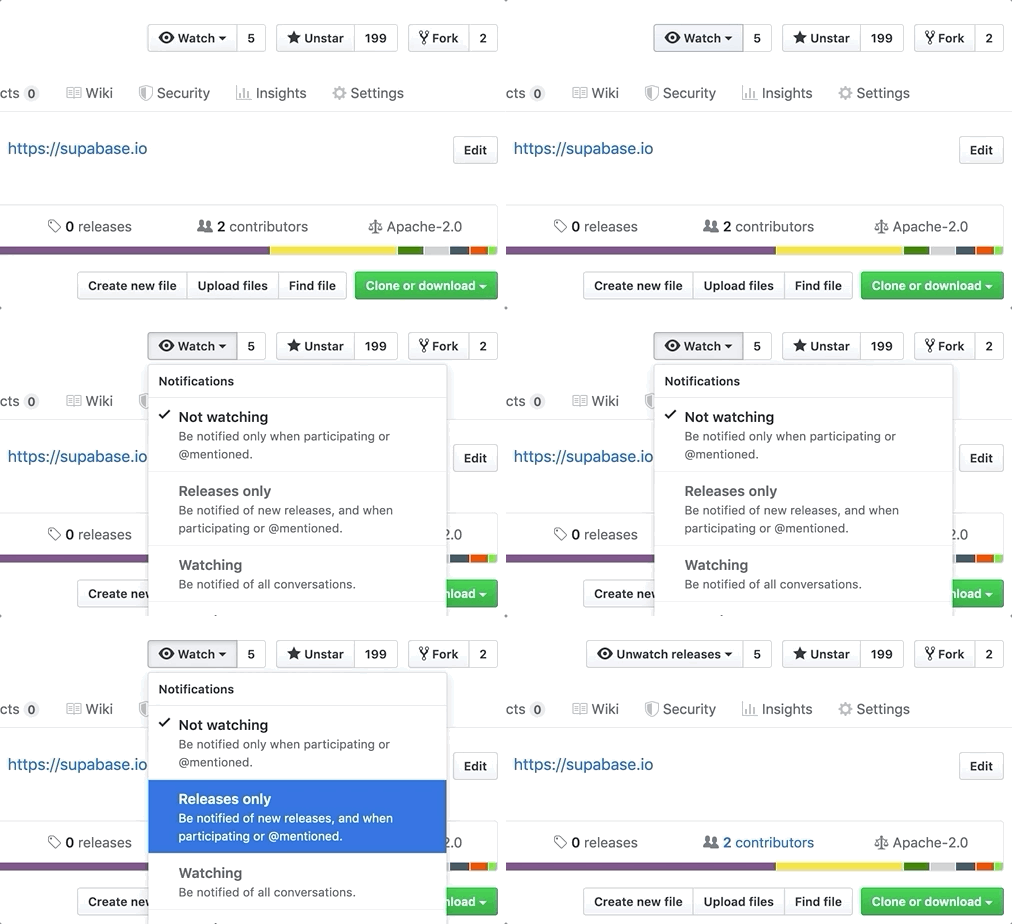
Watch "releases" of this repo to get notified of major updates.
Documentation
For full documentation, visit supabase.com/docs
To see how to Contribute, visit Getting Started
Community & Support
- Community Forum. Best for: help with building, discussion about database best practices.
- GitHub Issues. Best for: bugs and errors you encounter using Supabase.
- Email Support. Best for: problems with your database or infrastructure.
- Discord. Best for: sharing your applications and hanging out with the community.
How it works
Supabase is a combination of open source tools. We’re building the features of Firebase using enterprise-grade, open source products. If the tools and communities exist, with an MIT, Apache 2, or equivalent open license, we will use and support that tool. If the tool doesn't exist, we build and open source it ourselves. Supabase is not a 1-to-1 mapping of Firebase. Our aim is to give developers a Firebase-like developer experience using open source tools.
Architecture
Supabase is a hosted platform. You can sign up and start using Supabase without installing anything. You can also self-host and develop locally.

- Postgres is an object-relational database system with over 30 years of active development that has earned it a strong reputation for reliability, feature robustness, and performance.
- Realtime is an Elixir server that allows you to listen to PostgreSQL inserts, updates, and deletes using websockets. Realtime polls Postgres' built-in replication functionality for database changes, converts changes to JSON, then broadcasts the JSON over websockets to authorized clients.
- PostgREST is a web server that turns your PostgreSQL database directly into a RESTful API.
- GoTrue is a JWT-based authentication API that simplifies user sign-ups, logins, and session management in your applications.
- Storage a RESTful API for managing files in S3, with Postgres handling permissions.
- pg_graphql a PostgreSQL extension that exposes a GraphQL API.
- postgres-meta is a RESTful API for managing your Postgres, allowing you to fetch tables, add roles, and run queries, etc.
- Envoy is a cloud-native, high-performance edge and service proxy.
Client libraries
Our approach for client libraries is modular. Each sub-library is a standalone implementation for a single external system. This is one of the ways we support existing tools.
| Language | Client | Feature-Clients (bundled in Supabase client) | ||||
|---|---|---|---|---|---|---|
| Supabase | PostgREST | GoTrue | Realtime | Storage | Functions | |
| ⚡️ Official ⚡️ | ||||||
| JavaScript (TypeScript) | supabase-js | postgrest-js | auth-js | realtime-js | storage-js | functions-js |
| Flutter | supabase-flutter | postgrest-dart | gotrue-dart | realtime-dart | storage-dart | functions-dart |
| Swift | supabase-swift | postgrest-swift | auth-swift | realtime-swift | storage-swift | functions-swift |
| Python | supabase-py | postgrest-py | gotrue-py | realtime-py | storage-py | functions-py |
| 💚 Community 💚 | ||||||
| C# | supabase-csharp | postgrest-csharp | gotrue-csharp | realtime-csharp | storage-csharp | functions-csharp |
| Go | - | postgrest-go | gotrue-go | - | storage-go | functions-go |
| Java | - | - | gotrue-java | - | storage-java | - |
| Kotlin | supabase-kt | postgrest-kt | auth-kt | realtime-kt | storage-kt | functions-kt |
| Ruby | supabase-rb | postgrest-rb | - | - | - | - |
| Rust | - | postgrest-rs | - | - | - | - |
| Godot Engine (GDScript) | supabase-gdscript | - | - | - | - | - |
Badges

[](https://supabase.com)
<a href="https://supabase.com">
  <img
    width="168"
    height="30"
    src="https://supabase.com/badge-made-with-supabase.svg"
    alt="Made with Supabase"
  />
</a>

[](https://supabase.com)
<a href="https://supabase.com">
  <img
    width="168"
    height="30"
    src="https://supabase.com/badge-made-with-supabase-dark.svg"
    alt="Made with Supabase"
  />
</a>
Translations
- Arabic | العربية
- Albanian / Shqip
- Bangla / বাংলা
- Bulgarian / Български
- Catalan / Català
- Croatian / Hrvatski
- Czech / čeština
- Danish / Dansk
- Dutch / Nederlands
- English
- Estonian / eesti keel
- Finnish / Suomalainen
- French / Français
- German / Deutsch
- Greek / Ελληνικά
- Gujarati / ગુજરાતી
- Hebrew / עברית
- Hindi / हिंदी
- Hungarian / Magyar
- Nepali / नेपाली
- Indonesian / Bahasa Indonesia
- Italiano / Italian
- Japanese / 日本語
- Korean / 한국어
- Lithuanian / lietuvių
- Latvian / latviski
- Malay / Bahasa Malaysia
- Norwegian (Bokmål) / Norsk (Bokmål)
- Persian / فارسی
- Polish / Polski
- Portuguese / Português
- Portuguese (Brazilian) / Português Brasileiro
- Romanian / Română
- Russian / Pусский
- Serbian / Srpski
- Sinhala / සිංහල
- Slovak / slovenský
- Slovenian / Slovenščina
- Spanish / Español
- Simplified Chinese / 简体中文
- Swedish / Svenska
- Thai / ไทย
- Traditional Chinese / 繁體中文
- Turkish / Türkçe
- Ukrainian / Українська
- Vietnamese / Tiếng Việt
- List of translations