mirror of
https://github.com/langchain-ai/langchain.git
synced 2026-10-08 19:05:20 +03:00
 Max Caldwellandmaxtheman
3dc49a04a3
Max Caldwellandmaxtheman
3dc49a04a3
- Current docs are pointing to the wrong module, fixed - Added some explanation on how to find the necessary parameters - Added chat-based codegen example w/ retrievers Picture of the new page: 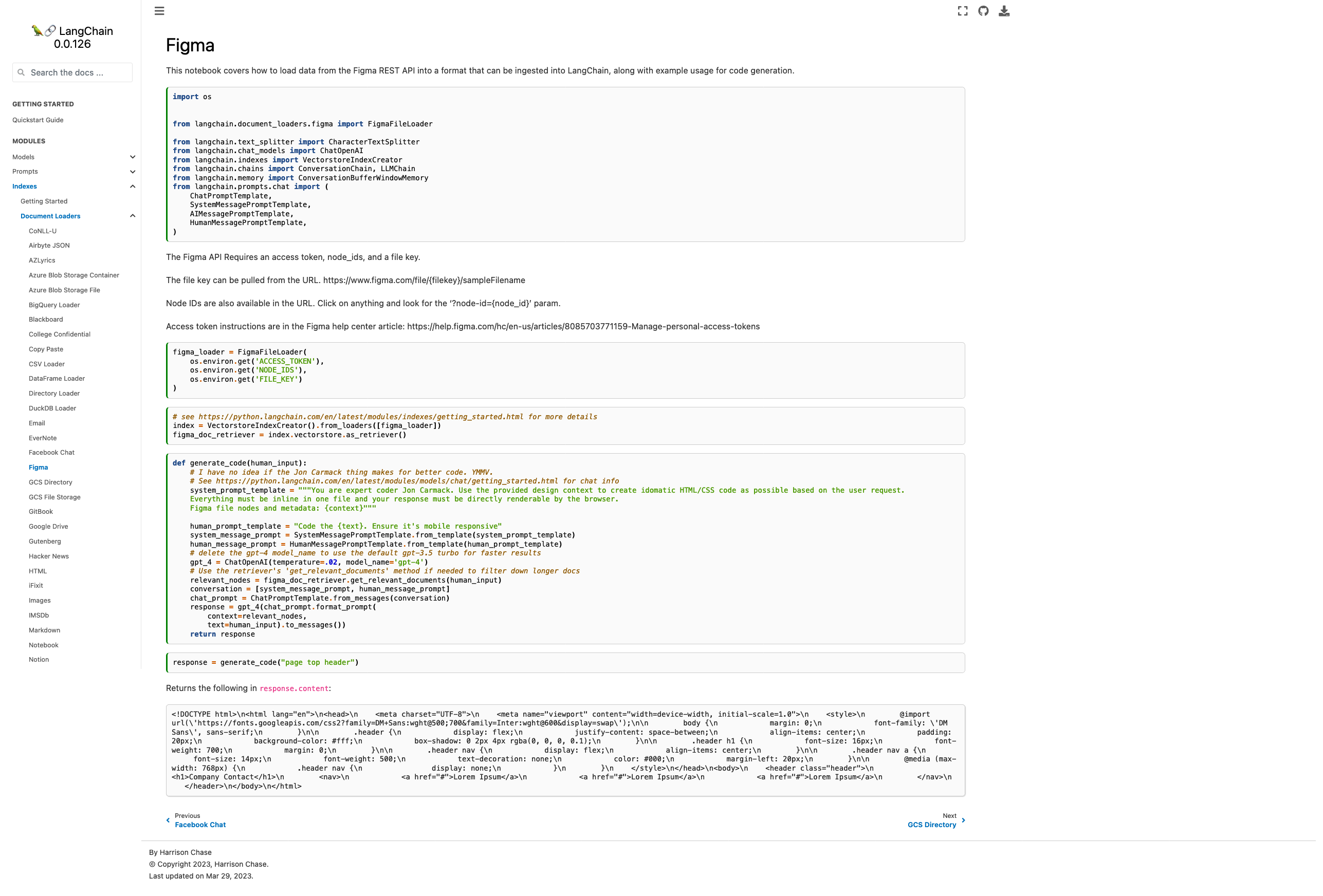 Please let me know if you'd like any tweaks! I wasn't sure if the example was too heavy for the page or not but decided "hey, I probably would want to see it" and so included it. Co-authored-by: maxtheman <max@maxs-mbp.lan>

6.4 KiB
6.4 KiB
In [ ]:
import os


from langchain.document_loaders.figma import FigmaFileLoader

from langchain.text_splitter import CharacterTextSplitter
from langchain.chat_models import ChatOpenAI
from langchain.indexes import VectorstoreIndexCreator
from langchain.chains import ConversationChain, LLMChain
from langchain.memory import ConversationBufferWindowMemory
from langchain.prompts.chat import (
    ChatPromptTemplate,
    SystemMessagePromptTemplate,
    AIMessagePromptTemplate,
    HumanMessagePromptTemplate,
)In [2]:
figma_loader = FigmaFileLoader(
    os.environ.get('ACCESS_TOKEN'),
    os.environ.get('NODE_IDS'),
    os.environ.get('FILE_KEY')
)
In [ ]:
# see https://python.langchain.com/en/latest/modules/indexes/getting_started.html for more details
index = VectorstoreIndexCreator().from_loaders([figma_loader])
figma_doc_retriever = index.vectorstore.as_retriever()
In [ ]:
def generate_code(human_input):
    # I have no idea if the Jon Carmack thing makes for better code. YMMV.
    # See https://python.langchain.com/en/latest/modules/models/chat/getting_started.html for chat info
    system_prompt_template = """You are expert coder Jon Carmack. Use the provided design context to create idomatic HTML/CSS code as possible based on the user request.
    Everything must be inline in one file and your response must be directly renderable by the browser.
    Figma file nodes and metadata: {context}"""

    human_prompt_template = "Code the {text}. Ensure it's mobile responsive"
    system_message_prompt = SystemMessagePromptTemplate.from_template(system_prompt_template)
    human_message_prompt = HumanMessagePromptTemplate.from_template(human_prompt_template)
    # delete the gpt-4 model_name to use the default gpt-3.5 turbo for faster results
    gpt_4 = ChatOpenAI(temperature=.02, model_name='gpt-4')
    # Use the retriever's 'get_relevant_documents' method if needed to filter down longer docs
    relevant_nodes = figma_doc_retriever.get_relevant_documents(human_input)
    conversation = [system_message_prompt, human_message_prompt]
    chat_prompt = ChatPromptTemplate.from_messages(conversation)
    response = gpt_4(chat_prompt.format_prompt(
        context=relevant_nodes,
        text=human_input).to_messages())
    return response
In [ ]:
response = generate_code("page top header")